Let’s Make the Walls Come Tumbling Down

We live in a society that places a huge amount of importance on the appearance of happiness. We are expected to seem happy all the time. For anyone who is living with any kind of mental illness, or any long term physical illness or disability, people seem to care more about whether you look happy, or whether you are making an effort to be happy, than walking alongside you in what might be a difficult journey.

We also live in a world where people behave as though mental and physical illness might be catching. Don’t go on about your difficulties. People don’t want to know. Don’t talk about the hard thing that happened to you, you’ll upset people.

Most people who get pregnant for the first time are advised not to tell most people in their lives until after the twelve week scan. The horrendously misleading phrase that is often used is that it will be “safe” after that. This contains within it the assumption that miscarriage should be a secret. It’s also completely misleading. The reality is that babies, and mothers too, can and do die after multiple successful scans. Pregnancy and childbirth are not safe for the child or for the mother. The UK is a comparatively safe place to be pregnant and give birth, and to gestate and be born. And still, mothers and babies die every day.

Losing Gracie Wren made me into a different person, but because talking about miscarriage is taboo, I hid it as well as I could. With my husband’s agreement I posted during Baby Loss Awareness Week that year, and I selected the people who saw that post very carefully.

Losing the twins changed the way I talk about grief and loss and changed the way I behave. I began to question why something as common as miscarriage is such a taboo. A lot of people are deeply shocked when I mention that one in four pregnancies ends in miscarriage. So many families feel they have to wall up their grief to protect society. And society encourages that. Many people who experience miscarriage report feeling very bleak and alone, and it takes a great deal of courage to open up to even one person.

Our world pathologises grief. Grief is something to “get over”. We’re supposed to “move on”. People say this to people who have lost parents and spouses and adult children, let alone to parents who have lost babies, either before or after birth.

But grief is a permanent change.

Of course I’m not saying that people who live with grief will never be happy again. It’s possible to live with grief and embrace joy (I try to do it every day). But it’s impossible to know when grief will hit. The waves might get less frequent, they might get smaller – although neither of these will necessarily happen. The only thing that is more or less predictable about grief is its utter unpredictability.

Do you live with grief?

Have you experienced miscarriage or baby loss?

If you have, you might feel as though you are supposed to keep all your feelings, all your sadness, all your fears about the future, behind a wall. You might even be encouraged by others to make sure the wall is firm and solid. People can say well intentioned things that sound more like, “Please be quiet about the things that make you sad.” Has anyone ever said, “Be thankful for what you have,” or, “Lots of people are going through much worse things than you are.” I always take statements like this as a not very subtle request to shut up. It’s possible that this is not what’s intended by people who say such things, but it is what it sounds like from this side of the wall.

It’s been a slow process, but during the weeks and months after losing the twins, I began to take down the wall.

I can’t even say it’s as fast as brick by brick. Sometimes I just scrape away a tiny piece of mortar. Sometimes I lean on the wall, too exhausted to move, and when I finally stand up I find that two or three bricks have fallen out.

I don’t want anyone to feel they have to hide their real life behind a wall. I am only one person, but this is how it starts. One conversation at a time. One Facebook post, one blog post at a time.

Of course, for some people the wall represents safety. The last thing I want is to take down walls that people want or need.

But some of us feel stuck behind a wall that society built in front of us. I am trying to change the nature of the walls so that nobody will need to keep their miscarriage, the loss of their beloved child, a secret in order to protect other people from their sadness. At present, for most people, the choice is between keeping quiet or being quite loud.

Let’s make the walls come tumbling down. Let those who wish, be quiet. Let those who need, shout it out. Let those who need something between the two extremes find their safe place. But let it be of our choosing.

Thirteen Months Later

This might be difficult to read, especially if you don’t like needles.

My little girl was only eleven months old when I had my first miscarriage (May 2016: see my previous post). She wasn’t used to being with anyone except me or my husband, so, the day after I came home from hospital and thirty-six hours after my emergency surgery, I went back to being a full time parent.

It’s very easy to say now what a big mistake that was, and it definitely had a major negative impact on my recovery. But even with the wisdom of hindsight, I can’t honestly say that there was an alternative. K’s grandparents tried to look after her. She adores them and always has, but at eleven months she couldn’t spend more than about an hour with them without becoming hysterical with fear, just because she was used to being with Mummy or Daddy.

In September that year I had a chemical pregnancy, which is a miscarriage before six weeks. Many people who have chemical pregnancies never know that they were pregnant. For me, this was significant mostly because it enabled me to begin to talk about my first miscarriage. I told very few people at first, mostly because I couldn’t talk about it without crying. In February 2017 I had another chemical pregnancy. Since K was coming up to two, it’s around this time that people started to cheerfully ask whether we’d thought about having another child. After the first couple of times, when I was struck dumb, I began to share my story.

Our house had been on the market for several months. We finally found a buyer and, a few weeks later, we found a wonderful house just round the corner from my parents. It’s very common in Scotland to have a few weeks between houses. We had four weeks between moving out of our old house and moving into the new one. We stayed with my parents for half the time, and for a fortnight in the middle we went on holiday and left our cat with them.

I knew that my period was late because of the stress of moving. But my husband persuaded me to do a test to put my mind at rest, because we were about to go abroad for a fortnight. A year and a day after we found out that Gracie Wren had died, I had a positive pregnancy test.

We had a lovely holiday. As soon as we got back I saw my GP, who arranged a scan for me on my fortieth birthday.

Having been through a miscarriage the year before, I found it impossible to relax during this pregnancy. I had pretty strong symptoms, which definitely helped, but I was also completely exhausted, all the time. It was impossible to tell how much of the exhaustion was pregnancy related and how much was moving house related, how much was caused by stress and how much was just normal, toddler-parenting tiredness.

But it was also a time of quiet joy. After all the grief the year before, it felt like a redemption, that we were moving into our dream house and had a new baby on the way.

My husband was really excited that I was having a scan on my birthday. He said that it was going to be great because we would see the baby’s heartbeat and it would set my mind at rest, and it was going to be a wonderful birthday present.

The scan took place in the room where we found out that Gracie Wren had died.

I was diagnosed with fibroids and a retro tilted womb during my pregnancy with K, but neither was an issue and they didn’t affect any of the scans (and I had a lot of scans). My first scan with K was at five and a half weeks, because I had been bleeding heavily. We saw a strong heartbeat that day. This time, it was four and a half weeks since my positive test, which meant that I was at least eight weeks pregnant. But the midwife had a lot of trouble finding the sac and couldn’t find a heartbeat at all. She said that I couldn’t be more than four weeks, but we knew that definitely wasn’t right. So she scheduled a scan with the consultant gynaecologist for eight days later. And my mind wasn’t put at rest at all. I’ve felt ever since that I didn’t get a proper fortieth birthday. K turned two, two days later.

Six days after that, on June 21st, we saw the lovely gynaecologist who delivered K. Everyone who knows him respects and values him and he is such a caring doctor. And he had to tell us that I was carrying twins, but because he couldn’t find any heartbeats although I must be at least nine weeks, he didn’t know whether it was a viable pregnancy. He said he would see me in a week’s time, but that he wouldn’t be surprised if I had a miscarriage before he could see me again.

I don’t have words for all the emotions I took away from that appointment. Twins! We always wanted twins! But possibly not viable. But twins! The next few days were some of the longest I ever remember.

I started spotting on the Saturday, but spotting on its own doesn’t indicate anything sinister. On the Monday evening, once K was asleep, I went to bed early, because I was so tired I could hardly stand up. I lay in bed praying for our twins. Suddenly I felt a gentle “pop”, deep inside, followed instantly by a flood of blood. I knew that was it.

Once again, just like the year before, we had to wait over an hour after calling the ambulance for it to arrive. At least K was asleep this time, so my mum stayed with her whilst my husband followed the ambulance. Once again, the journey was interminable and made me feel even more unwell. I kept having flashbacks to losing Gracie Wren, which definitely didn’t help.

I was in a great deal of pain this time, much worse than I ever was with Gracie Wren. One of the ways my body copes with pain is to imagine how much worse it could be. So when the doctor asked me to compare my pain to the worst pain I could imagine, I said five. My husband was able to get me to see that they really wanted me to compare this to the worst pain I’d ever had, so when they came back I was able to say that it was actually ten. After the strong painkillers it went down to nine and a half, but the pain stayed really bad all through that long night.

The doctor on duty wanted to do an internal scan because she couldn’t determine whether or not I needed surgery. For some reason the wand made the already severe pain significantly worse. My husband asked me why I hadn’t cried out, and he said that because I didn’t, they had no idea how painful it was. But if it was a necessary medical procedure, why would it matter that it hurt?

The doctor decided that I didn’t need surgery straight away, but that the consultant might decide to operate in the morning. So I needed to stay nil by mouth. The doctor had managed to get a line into my arm, no mean feat with collapsible veins like mine, and I was on a saline drip.

So now there was nothing to do except wait for the morning. My husband went home and I tried to get some sleep, without much success. Eventually I dozed off.

At about two o’clock in the morning, the drip started to sound an alarm. My vein had collapsed and the line had fallen out. The doctor on duty said that I needed to have a line in place in case I needed surgery in the morning. So she tried to get a large needle into my arm three times, and the three veins she tried all collapsed.

So she called in her superior, who also tried three times, and three more veins collapsed.

The next person to come in introduced herself as a nurse practitioner. By this time I seemed to be watching what was going on from somewhere near the ceiling. I certainly wasn’t capable of pointing out how insane this process was, how much unnecessary pain it was causing. She wasn’t successful either, and neither were her two colleagues on their first or second attempts.

A nurse came in to take my vitals and made a joke about how I had become a challenge and the three nurse practitioners were betting cups of coffee on who would manage to get a large needle into my poor bruised arms.

Eventually, at about four o’clock, one of them succeeded. I think it was the fifteenth attempt but I admit I lost count.

The care I received in the morning was much better than the year before. I saw the consultant more than once: initially for the tests to determine that this time I didn’t need surgery (whereupon the drip that had caused so much pain was cheerfully ripped out), and later in the morning to discuss next steps. Because this was my fourth miscarriage she wanted to carry out further tests over the weeks ahead, and she discussed them before I went home. I was able to ask her what I might expect in terms of bleeding and pain, and she was very helpful.

But unfortunately, my abiding memory of that hospital stay is what happened in the middle of the night.

I was the patient and I was in the worst pain of my life, physically and emotionally, even before they started the needle process. I can see how people might get carried away, especially on a night shift. But I didn’t really need the drip. If I had needed surgery in the morning, they could have put a line in once I was under anaesthetic. I find it hard to understand why it is necessary to keep someone awake for an hour and a half in the middle of the night, sticking large needles into their arms and leaving huge bruises.

Once again, I don’t think anyone was malicious. I have no desire to punish anyone for what I really believe was a mistake. I do believe that the people responsible for my care forgot that I wasn’t just an anonymous case in a hospital bed. I think they forgot to treat me like a living, breathing and suffering person. I think they got so focussed on the challenge of getting a working drip line into my arm that they completely forgot that there was no urgency at all, and that it would have been better for me right then, and for my future peace of mind, if they had let me sleep.

I still dream about needles nearly two years later. I dream the very specific pain of a needle moving round inside my arm searching for a vein. I dream so vividly that I check my arms for bruises when I wake up.

We lost both our twins that night. I bled very heavily for about ten days, and about as heavily as a heavy period for another three and a half weeks. A few weeks later, we agreed to name the twins Thomas, which means Twin, and Perdita, which means Lost Child.

Three years ago

This may be upsetting for some people to read. It’s taken me three years to be able to write it down.

I know that nurses, midwives and doctors work long hours for comparatively little compensation. I am alive because of their hard work, and I will never cease to be grateful for that.

I know that miscarriage is very common. It’s something they see every day. It is completely reasonable that for them, it is an everyday part of their routine. But for the person in the bed, this is not and can never be routine.

On the 12th May 2016, I’d been spotting for about a week. We had already seen our baby’s heartbeat, and the routine twelve week scan was scheduled for the following week. I bled heavily during my first pregnancy, and K is nearly four years old now. But when the spotting increased to a light flow, I phoned the pregnancy assessment unit and they asked me to come in.

My little girl’s godmother looked after her for a few hours. She was only eleven months old, such a tiny little thing.

It was obvious from the scan image that our baby had died. The midwives were kind. They explained that I had three options. I could schedule a D&E procedure, which would involve a general anaesthetic. I could take medicine to speed up the evacuation process. Or I could allow the miscarriage to proceed naturally. They explained that if I took that route I must expect a lot of pain and bleeding, but because I was already bleeding, they believed that process would be relatively straightforward.

Perhaps because I need to take several medicines every day, I prefer to let things happen naturally when it’s safe to do so. There was no medical indication that it might not be safe. They told me if the bleeding became very heavy, or if I was worried for any reason, I should call the Pregnancy Assessment Unit during office hours and the gynaecological ward out of hours.

On the way home from hospital, we named our baby Gracie Wren.

The next three days were quiet and sad. I was bleeding and in pain, but it was no worse than a heavy period.

My husband went back to work on the Monday. I took my daughter to her usual toddler group. We had a prior arrangement to meet a friend for lunch, which we did. I remember that the friend had a little gift for my daughter, which she was delighted with.

We got home around half past two, and at three o’clock my mum called round. This was a regular arrangement. She came most days to play with my daughter for an hour or so whilst I caught up with chores. This particular day, the bleeding suddenly got very heavy and painful. I’d been told to expect it to get heavy and painful, so I took the painkillers I’d been given and got on with whatever I was doing.

Before my mum left, I needed to change my towel again. But the alarm bells still didn’t ring. The advice is always that if you soak through a sanitary towel in less than an hour, you may be haemorrhaging. But I can say from vivid experience that it’s very easy to think, oh, that was a quick gush of blood, or a lot of clots. That doesn’t count.

I sat on the settee, cuddling my daughter and singing to try to get her to sleep. She was reluctant to drop off. My husband got home just before five: he had a work meeting from 5-6 on a Monday and he used to come home early and dial in, so that he was home by six o’clock as usual. I handed our daughter to him and stood up.

There was blood everywhere.

I opened my mouth to scream. My husband put his hand on my shoulder and said it would be okay. Of course, it would be easier for everyone if I didn’t scare the baby by screaming!

I threw my clothes into the bath and sat on the toilet and bled heavily for an hour.

My husband (my hero) got the baby to sleep in her cot, which was rare in those days! He cleaned the settee. He phoned into his meeting.

I realised that I was bleeding too much. At the end of his meeting I told my husband so and phoned the gynaecological ward. I spoke to a doctor and described my symptoms. She told me to call an ambulance. I remember her saying, “We need to see you, but don’t get someone to drive you to hospital. Do you understand? Put the phone down and call an ambulance.”

I put the phone down. My husband called an ambulance, and then my parents. But the reality of living in a small rural town is that sometimes you have to wait for an ambulance to arrive. My husband helped me pack an overnight bag, but I didn’t think of a lot of things that would have been useful.

I was still bleeding very heavily and by now I realised that it was too much blood, that I was losing too much too fast. I have a vivid memory of looking back, as I got into the ambulance, and seeing my little girl pressed against the French windows reaching for me. I wasn’t completely sure that I would ever get to see her again.

My lovely mum came in the ambulance with me. It was a horrible journey. I feel travel sick at the best of times, so lying on a gurney, going backwards, with no window to look out of, wasn’t great. The bleeding was still heavy and the pain was bad. The paramedic gave me some gas and air, but she didn’t really explain how to use it and I briefly passed out.

It all gets a bit blurry after that. I know they took me straight up to the ward on the gurney. There was some waiting between seeing various people but I don’t know how long it all took. I had internal and external scans and the doctor said I needed to have surgery immediately, as without it I would carry on bleeding until there wasn’t any blood left.

An anaesthetist came to talk to me. It’s strange how vividly some things stand out. I remember that he asked if I’d ever had an anaesthetic before, and when I said no, he laughed and said, “But you’ve had a caesarian!” I couldn’t work out how to explain that because of my peculiar heart, the anaesthetist used an epidural to numb me rather than a conventional spinal, so I just said, “Yes, but it wasn’t a general anaesthetic.”

The next thing I remember is being wheeled along on a gurney (really not a good way to move around when you get motion sickness) and asking, “Have you done it yet?” several times. I got back to the ward and was moved onto the bed. Both my parents were waiting to see me and they’d been well looked after whilst they were waiting: the ward staff had given them some tea and sandwiches. Once they were sure the operation had been a success they went home. It was so kind of them to stay and so lonely when they went.

I would have loved a cup of tea.

I was hooked up to a saline drip so I wasn’t technically thirsty. It was the middle of the night, about midnight, and the night staff don’t really have facilities to feed the patients. But I hadn’t eaten or drunk anything since about three o’clock in the afternoon, I had just undergone emergency surgery, I was beginning to take in the fact that the surgery was necessary because I would have died without it, I couldn’t sleep, and I was in a lot of physical and emotional pain. A cup of tea and a piece of toast would have made a huge difference that night.

In the morning, after I had at last had some breakfast, I expected someone to come in and tell me what I could expect to happen next. How long I might bleed for, how much pain I could expect, whether there were likely to be any side effects from the anaesthetic, whether there was anything worrying that I should look out for. When it got to eleven o’clock and nobody had come to talk to me, I started asking. Plenty of people came into my room to do various checks – nurses and support staff and a junior doctor. I said that I didn’t know what symptoms I could expect and I needed to talk to someone. I said please several times. I even cried.

Eventually someone came and said I could go home. My husband and daughter were there by then. I said that I still didn’t know what I could expect to happen and she said that if I was worried I should phone the ward or see my GP.

So I went home.

The next day I had a lot of unexpected pain in my arms and chest. When I rang the ward the doctor seemed impatient. “It’s just referred pain from the anaesthetic, it’s completely normal and expected.” When I said that nobody had told me to expect it she asked if I had any more questions.

I do not believe the medical staff at any time intended to be neglectful. I think I suffered because they didn’t think. I think they forgot that I wasn’t just a routine, albeit emergency, surgery. Diagnosis, surgery, quick march, very efficient, bed will be free by lunchtime.

I think they forgot that I didn’t have all the information they did. I think they forgot that I would have questions that needed answers. I think they forgot that the whole thing happened because my baby died, and I almost died, and no matter how frequently that happens, it is not routine. It’s extremely common, but that just means that a lot of people need a bit of consideration and compassion.

I bled fairly lightly for about three weeks and the pain wasn’t too bad. But I am still reeling from the trauma. I still have nights when I lie awake for hours. Would this be any different if someone had answered my questions when I begged them to?

I will never know.

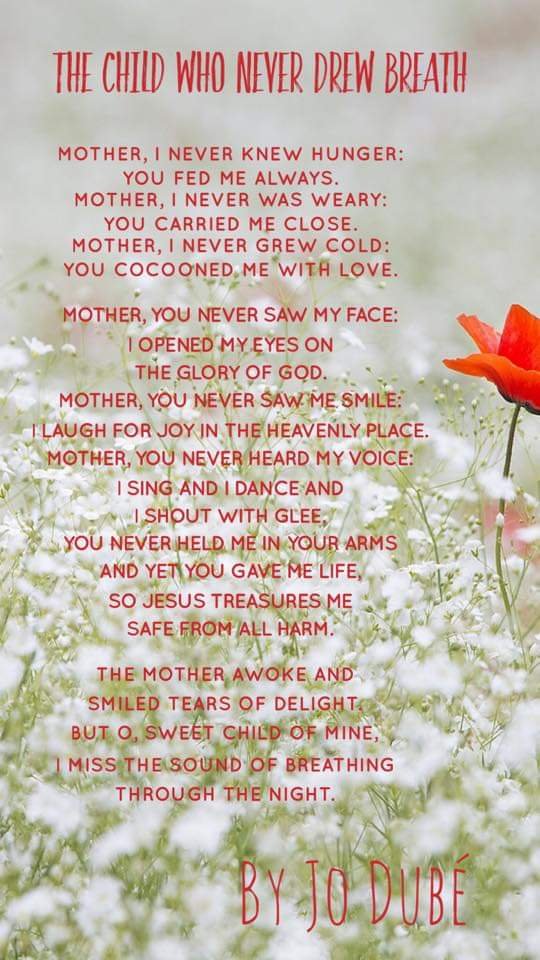
The Child who Never Drew Breath

Mother, I never knew hunger:
You fed me always.
Mother, I never was weary:
You carried me close.
Mother, I never grew cold:
You cocooned me with love.

Mother, you never saw my face:
I opened my eyes on the glory of God.
Mother, you never saw me smile:
I laugh for joy in the heavenly place.
Mother, you never heard my voice:
I sing and I dance and I shout with glee.
You never held me in your arms
And yet you gave me life,
So Jesus treasures me safe from all harm.

The mother awoke and smiled tears of delight.
But O, sweet child of mine,
I miss the sound of breathing through the night.

Faithful to His Promises

I’ve always loved Christmas. The special music, the way people light up their homes, the smells… I love choosing gifts for people and yes, I’ll be honest, I love seeing the gifts people have chosen for me. These last few years of grieving and depression, I’ve had a much needed and very welcome respite of a few weeks. Christmas is a time that’s full of promises. Even if it’s a secular celebration for you, there are gifts to wrap and unwrap, a slap up meal, and probably parties with family and friends. When it’s a religious celebration, there is all that and the memory of a special baby.

Jesus is unique, a very special covenant, but every baby is a promise. Even before a wanted baby is conceived, the idea is a promise that the parents treasure, sometimes for many years. Someone told me that they didn’t understand why people were so upset by miscarriage because it’s not as though we’ve lost a real person. It’s true that a baby who died before birth is not a person who has ever lived an independent life. But we have lost the promise of a person we are longing to meet. Both parents may have dreamt about this person for decades. Four grandparents may have hoped to meet them for even longer. Siblings, aunts and uncles, cousins, friends… when we are born we are already connected to dozens of people, and most of these connections extend backwards before birth.

I’ve been thinking a lot about God and promises recently. Husband and I have both been sure, since before we were married, that God has promised us more than one child. Neither of us believes that promise has changed. But I made assumptions about what “more than one child” looked like, and I need to accept those assumptions and accept that even when the answer to prayer doesn’t look the way we thought it would, that doesn’t mean the prayer has not been answered.

We have conceived seven children, and death is never part of God’s plan. Maybe these are all our biological children. Maybe there won’t be any more. That will not mean our prayers were not answered. Maybe we will become parents in some less typical way.

We’re too old to begin the process for conventional adoption, something that is never straightforward and brings significant risks for all concerned. But with God, all things are possible. God doesn’t care whether or not something is achievable in human terms.

Maybe the parenting God has planned for us, apart from our precious K, looks different from anything we can imagine.

Maybe, after all, we will conceive again and I will successfully carry our rainbow and give birth.

Our prayers are not denied when they are delayed. Our prayers are always heard and always answered: but even when the answer is Yes, that will not necessarily look like the Yes we imagined when we prayed.

img_20190124_142638216

(Drawing by Hannah Dunnett, coloured by me.)

Two Steps Forward, One Step… Sideways

In any journey through depression and grief, there are steps forwards, and there are days when we run as fast as we possibly can and stay in the same place. And there are days when we feel as though we are plunging into deep darkness, when the progress we were making so slowly and painstakingly seems to have stalled. Days when we seem to be peering at everything through a layer of treacle, sticky and dark. It’s very easy to feel as though we’re tumbling backwards, as though the fragile progress we worked so hard for has just slipped away.

Grief changes everything. Once we have experienced and lived with grief, real grief, we will never be the same again. Grief for the loss of an infant is a harder, longer journey, because we cannot say, “She had a long life.” We cannot say, “It was his time.” This is a lonely kind of death, for those of us left behind.

Our babies are not lonely. They have never experienced hunger, cold, or thirst. They were surrounded by love for their whole lives, and from our wombs they went straight to the arms of Jesus. I cannot pity them.

But we are lonely even when we’re not alone, we parents with aching arms, we siblings with no-one walking beside us. It is us whom I pity.

I’ve seen grief compared to a journey. This is not altogether useful. It is a journey whose beginning we do not choose, much of which we do not enjoy, and which will end only with our own death. But the analogy isn’t completely unhelpful. It is like a journey in that every painstaking step takes us further from the beginning. And we are, slowly and inexorably, travelling upwards, without stopping.

Yes, there are days, weeks, sometimes months when we stumble into the darkness after a period of relative light. But these are not backward steps. They are not even diversions from the steady upward trend. They are sidesteps.

My latest period of darkness started over a conversation with a dear friend. Our first children are very close in age, about ten weeks apart. We were talking about ante-preschool placements and she mentioned how valuable it is to have guaranteed time to spend with her younger child and to take part in activities for the younger one. We were both shocked when her words felt like a punch to my diaphragm.

I have so much time now. Since August I’ve been wondering why I seem unable to make better use of it. And suddenly I understand.

I should not be spending the time alone. I should be spending it with my younger children. But they are not here. Instead of packing people into warm clothes and then into pushchairs and heading into town to a toddler group, I go back home, alone, to an empty house.

But – this is important – although this has been the trigger for an intense period of grieving, it is not a backwards step. I have not tumbled back into darkness. I have stepped forward to embrace the next patch of darkness on my journey.

Does this feel very different?

Not at the moment. At the moment I am sad. I’m tired. I lack energy. I’m close to tears all the time. My patience with poor K is not great. This is what depression looks and feels like. And it will last as long as it lasts. I can’t wave a magic wand to make it go away. I can’t do anything to speed it up. All I can do is be patient, and try to be kind to myself.

But I’ve travelled far enough along this path to be sure that it is how I will feel when this bleak darkness retreats that matters.

I needed to acknowledge that I miss my little ones. Yes, I talk and write about baby loss and miscarriage, and that’s important, but most of my children would not be tiny babies any more, and it’s not tiny babies I am missing. And that matters.

So I am certain that this is a sidestep on my journey, and that when I find the light again, I will find I have stepped upwards, perhaps significantly so.

But it doesn’t feel like it at the moment.

Lighten Our Darkness

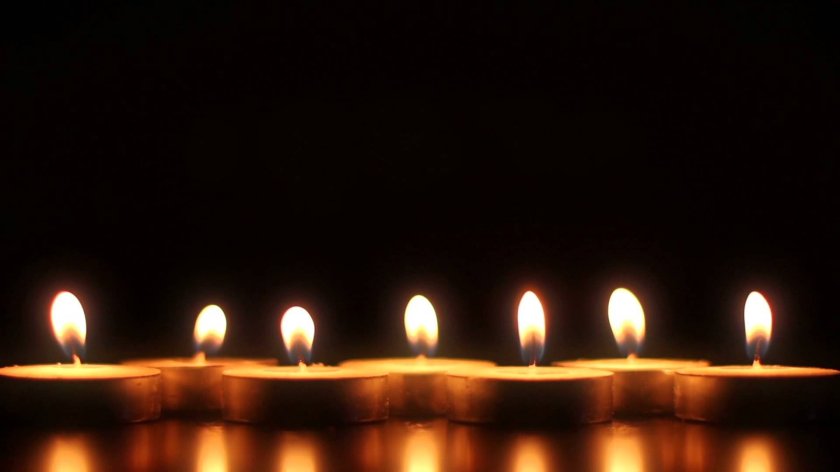
This evening at seven o’clock, many people will light a candle in their homes in memory of their lost children. Others who have not experienced loss directly will do so in solidarity with those of us who live with loss.

And many people share images of their candles (or any candles, if they’re not in a position to light real ones) on social media. This can be immensely powerful. For a short time, the world comes together to remember all our precious little ones.

But this evening isn’t actually for us. It isn’t for our babies. It’s for you.

For you, the lucky ones who get to parent all the children you conceived.

For you, the child free by choice.

For you, who want to have children but haven’t started that journey yet.

You absolutely have not done anything wrong. It’s great that you can live your life every day without thinking about miscarriage, pregnancy and infant death. These are terrible things and they’re not fun to think about. I am absolutely not trying to imply that you have anything to feel bad about.

But we haven’t done anything wrong either, and we can never stop thinking about it.

The image at the top of my blog, the picture of a row of angels, is in our kitchen, on top of the dresser. They were painted for us by a friend of a friend in memory of our angels, and we keep them where we can see them many times a day. Not because we need to be reminded, but because they are part of our lives anyway, and it helps to have a visual presence. Not all bereaved families find the imagery of angels helpful, but many do.

K doesn’t ask or talk about them much, but she has told me more than once that Mummy made angels and they never go away.

I am not the only person who is trying to break the taboo against talking about baby loss, one conversation, one blog, one Facebook post at a time. Because it is a taboo, you who live your lives free of its shadow probably have no idea how common it is.

Please take the time, this evening, to think of those you know, and those you don’t, whose lives have been changed forever. Baby loss divides your life sharply, into Before (the world was full of pain and darkness) and After. I hope that very few of you are living Before. If you can, light a candle tonight, of post a picture of a candle, and think of us who are now, and always will, be living After.

Wonderful, terrible October

If you use social media in any form, you will be aware by now that October is Baby Loss Awareness Month. This is a time when people who are keep quiet for the rest of the year often speak out about their experiences. It’s incredible. Witnessing other people’s testimonies is what helped me begin to speak out two years ago. I was in the depths of depression and despair at the time, and I had not yet been able to accept or face up to the fact that when we lost Gracie Wren, I nearly died too. Suddenly, my news feed was full of people saying things like, “I am the one in four,” referring to the fact that one in four pregnancies ends with loss. I realised that although miscarriage and baby loss are very common, and although speaking about it is one of life’s big taboos, my experience matters too.

That statistic, one in four, is both helpful and unhelpful. Knowing that we are far from being alone is very helpful, but like all statistics, it depersonalises something very personal.

We live at a time and in a society when we do not expect to lose our children. We expect parents to die after a long life, before their children. Any family that doesn’t conform to this norm can make people uncomfortable. Our baby died, I nearly died, and this is such a common experience that society expects us to get up and carry on as though nothing has happened, because thinking about it makes people feel bad. I felt obliged to keep quiet because I knew that if I talked about it I would cry, and people don’t like that because it makes them uncomfortable.

That was two years ago. Since then, I have talked about it a lot and cried a lot. I’ve had more losses. I am open about the fact that there are seven children in our family, even though only the eldest is living.

Statistics are misleading. One in four pregnancies ends in loss, but I know several families who have four or more children who have never experienced loss. And I know families who have experienced multiple losses, a lot more than I have, who have never had the chance to bring home a living child. Speaking about this is one of the biggest taboos of our time. Not all mothers have living children. Not all mothers who have living children only have the ones you see.

So if this is so common, why does it matter? If twenty-five percent of pregnancies end with the death of the infant, why are people shocked when it happens? And why does it matter?

The received wisdom is that it’s better not to announce your pregnancy until after the scan at twelve weeks. The term that is often banded around is that it’s “safe” after that. But there are so many things wrong with this way of thinking, which is encouraged by midwives and medical professionals. It contains within it the assumption that if you lose your baby before twelve weeks, you won’t tell anyone. And it also encourages the belief that there is a magical transformation after which the baby you are carrying is safe.

The reality is that unborn babies can and do die at any time during pregnancy, sometimes for no identifiable reason. Research is constantly taking place to attempt to reduce this, and there are things that expectant mothers can do to decrease the risk for their baby. (I’ll write about those another day.) But the reality is that carrying or being an unborn baby is still dangerous for the infant and the parent, and tiny babies are so vulnerable that the danger doesn’t entirely go away even after birth.

As well as the mental and emotional impact, there’s another aspect that is even less spoken of. Every pregnancy changes the mother’s body, and some of the changes are permanent. Even if the pregnancy only lasts a few weeks or months, there is no going back physically any more than emotionally. One of the giveaways that I am pregnant is that tap water, any still water, tastes strongly metallic, and as the pregnancy progresses it gets harder to drink it without gagging. Outside pregnancy, I can drink tap water, but it still has a metallic aftertaste that was never there before. There are other physical changes – stretch marks, the size and shape of your breasts – that will never change back after pregnancy.

What does all this have to do with Baby Loss Awareness Month? Everything I write here is about increasing awareness in one way or another, so all my blog posts are relevant in October. But there is one other aspect of this month that I want to mention particularly to people who are supporting a loved one who has suffered a miscarriage or baby loss.

Having a whole month dedicated to trying to reduce the taboo is amazing. It’s a very positive and rewarding experience for so many of us. It leads people to speak out who were not able to before.

And at the same time, October is difficult. It’s impossible to spend any time on social media without being reminded what month it is, and that can be triggering.

Dear Lord, thank you for this terrible, wonderful month of October. Thank you for a whole month every year when those of us who need to are encouraged to speak out. Thank you for every person touched by loss whose sealed lips will be loosed this month for the first time. And, dear Lord, please give each of us the strength we need when our grief is triggered by another’s words or image. Help us to support each other in our grief and to be there for those we love. Amen.

How to Help (maybe)

I’m sorry if anyone was upset by my last post. I know that a lot of the unhelpful things people say come from a place of love. When someone you care about is hurting, it’s natural to want to offer comfort or help them find the bright side. But when you have lost your baby, there isn’t a bright side, and your helpful words might be very hurtful.

There are a lot of things you can do to help, though.

1) Be there. Don’t run away. Some people don’t want to mention the loss because they think they will upset their friend. But she’s already upset. Yes, she might cry when you mention her baby. Pass her a tissue. Offer a hug.

2. If you hear about the loss soon after it’s happened, don’t wait till she asks for help because she probably won’t, but that doesn’t mean she doesn’t need help. Take a meal to the family, or look after the kid(s) for a few hours. For the first two or three weeks (yes, that long) she will probably be in a lot of physical pain and still bleeding heavily. Rest is the best medicine at this point. If you don’t live nearby, order a takeaway to be delivered (let them know it’s coming to avoid duplicates).

3) Send her something lovely. I received chocolates, cake, flowers, pampering goodies and colouring supplies and they helped more than I can say. And you don’t need to spend money. A text, a letter, a message on Facebook: these are all good. Anything but silence.

4) If either of the bereaved parents needs to cry at any time, support them. Offer a tissue, tea, chocolate… There isn’t a time limit on this. I haven’t had a new loss for several months and sometimes I still just need to cry.

5) Remember the missing child(ren). It doesn’t matter how long ago the loss was. Even if it was eighty years ago, if you ask a bereaved mummy how old her baby should be, she will probably be able to tell you.

(Gracie Wren should be 21 months old. Nearly two! I wonder if she would be using sentences yet? What would her favourite book be? Would she be mad about cuddly toys? Would she be a boy or a girl? Would he prefer cars or dolls?

The first chemical pregnancy should be nearly sixteen months old. Staggering all over the place on chunky legs, covered in bruises from random tumbles…

Second chemical pregnancy should be ten months old. We’d be starting to think about a birthday party! Would he or she be crawling, or would they reproduce big sister’s crazy bum shuffle?

Oh my little twins. They would never let me go full term with twins, so you’d be eight months old. Eight months! We’d be marvelling at how you got so big. Would you be cruising? Would you be climbing onto big sister’s trampoline? Would Peekaboo be the best game in the world? Would you conspire to keep Mummy and Daddy awake all night long?

And I should be holding my tiny newborn.)

Remember the baby’s due date, if you can. A “thinking of you” text on that day will mean so much, more than you can possibly imagine.

6) Don’t expect your friend or loved one to get back to normal. Don’t wait for her to recover, because she won’t. There will be a new normal, but she is not and never will be the person she was before. There will be plenty more good times. Love and laughter will help her recover more than anything else. But she is not the same.

7) You know the person you love better than I do. For some, the whole process of baby loss is intently private and they need most of all to be left alone (although she might still need help with her living children). Flowers helped me a lot, but I know someone who was horrified by a gift of flowers because they die, and so did her baby. These are ideas, not instructions.

8) Finally, anything that a bereaved mother tells you about her baby is important. Memories are all she has. For miscarriage and pregnancy loss, there are no photographs. If she tells you something about her pregnancy, including about the circumstances of the loss, that’s a precious gift.

Yes, I am including my words on this blog. Sharing my memories of my precious babies, of their brief lives and unforgettable deaths, is my gift to the world. If one person feels less alone; if one person learns what not to say; if one person can really help someone they love because of what I write, it will be well worth the tears and headaches.

So please, if my words resonate with you, share them with your world.

How Not To Help

When you have a friend or acquaintance who is living with baby loss, or any kind of bereavement, it can be really hard to know how to help. Many people instinctively want to make things better, so they try to offer comforting words. Here are some of the things people have said to me: people who really care, and who want to help me feel better.

“God needs your baby more than you do.”

“There must have been something wrong with the baby.”

“God never sends us more than we can deal with.”

“God knows you’re strong enough to cope.”

I’m assuming that if you are reading this, you really want to help your bereaved friend, so I want to break down why these are not helpful. I don’t want people to feel bad for trying to help – quite the reverse. I do want people to think about what they are saying.

“God needs your baby more than you do.” This is insulting to God and to me. It suggests that God is so weak that he needs to steal unborn babies. The natural and sensible response to a God like that would be to run far, far away, not to worship Him! I personally do believe that my babies are with God in Heaven, but that is because God has the power to redeem everything, not because He is so desperate for worshippers that He causes death.

“There must have been something wrong with the baby.” Well, yes, clearly there was something wrong or the baby wouldn’t have died. You probably wouldn’t think of telling me that grass tends to be green, but that won’t make me sad the way this does. My baby died because there was something wrong. I never had a chance to see or hold them. This is an immensely common tragedy that happens to a lot of people. That doesn’t make it less tragic. It just means that an awful lot of people are walking around with part of their hearts missing.

“God never sends us more than we can deal with.” “God knows you’re strong enough to cope.” Look, have you actually read the Bible? (If you’re not a Christian, fair enough. But presumably, if you aren’t a Christian, you won’t make the mistake of thinking this is a good thing to say.) The Bible is full of people who can’t cope with their lives. I’ll mention a few, but there are many.

Abraham and Sarah can’t cope with the long wait for the child God has promised them, so Abraham impregnates Sarah’s servant.

Naomi and Ruth can’t cope with no food and no reliable way to get any, so Ruth tricks Boaz into marrying her.

God speaks directly to Moses and gives him specific instructions, and Moses is so scared of the whole business that he can’t begin until he has Aaron to do the talking for him.

Elijah suffers from serious depression and asks God to kill him. Elisha panics when some young men make fun of him and sets bears on them.

Jeremiah spends most of his life fleeing persecution and death threats.

None of these people can cope without God and neither can I. Not being able to cope is not indicative of weakness, it’s a sign of humanity.

You may be wondering whether there is anything that it’s safe to say. It’s always safe to say, “I’m sorry.” If that feels inadequate, you could say, “I’m so sorry, that’s awful.”

If you really do want to help, there is a lot you can do. Come back soon for a more cheerful post about how you can help.