Sadness matters

Do you remember April 2020? Even though it’s only two years ago, we’ve been through so many changes that it can be difficult to remember exactly what was happening, and when.

In April 2020, covid-19 was still a very serious, life threatening illness. Apart from essential workers, the ruling was that everyone must stay at home. We were allowed to leave our homes for a daily hour of exercise, but not to meet up with anyone from another household. Playgrounds were padlocked. Only essential shopping, and mail order, were allowed.

My pandemic story is mostly a comparatively privileged one. I live in a big house full of books and craft materials; we have television and internet access; we were never concerned about money; we always had enough to eat. And I’m lucky enough to live with the two people I love most in the world.

After all our losses a few years before, my husband and I decided that if I got pregnant again, we would share the news with the world straight away. There are a few reasons for this.

Conventional wisdom advises that pregnancy should be a secret until after the usual scan at twelve weeks, but that advice contains within it the assumption that miscarriage, especially before twelve weeks, should be a secret. I’ve heard several people say that after twelve weeks, they know that they will be bringing a baby home. They feel that twelve weeks indicates a kind of safe zone. I’ve even heard medical professionals, who really should know better, perpetuate this myth. But the sad reality is that pregnancy is not safe. Babies, and mothers too, can and do die at any stage of pregnancy, up to and including delivery. The UK is one of the safest places in the world to be an unborn child or a pregnant mother, and still, babies and mothers die every single day.

Every one of our babies has been very much wanted. Every baby deserves to be celebrated. After six early losses, we knew that we might not get to bring our newest baby home. And so we wanted to celebrate our child whilst we could.

And, perhaps selfishly, after so many losses, I knew that if the worst happened and we did lose another baby, I would need all the support I could get.

In early April 2020, to my complete shock, I found out that I was pregnant. It was more than two years since my last miscarriage, so I was becoming reconciled to the thought that it wasn’t going to happen again. But then it did. We shared our news with our family and then with the world, as we had planned.

And then, once again, the worst happened. Our pandemic baby, Hope, became miscarriage number seven.

I needed the support of my friends and family even more than I had in previous losses.

And it was not available.

I don’t want to diminish the support I did receive. Many online friends were very supportive, and several people sent beautiful gifts.

And the things I needed most – hugs from friends, and someone to bring us a meal, and tea and sympathy, and fun outings for my daughter, and childcare for a few hours to give me space… none of these things were available.

My husband had recently had a significant promotion at work, so he was working hard and less available than usual (and of course, he was grieving, too). My child was only four, really struggling with the closure of her nursery, and she had no contact at all with other children. She and I were together, all day, every day, and she needed me to be present and paying attention.

There was no time and no space for my grief, let alone for healing.

And this is nobody’s fault. Absolutely nobody did anything wrong. Nobody let me down. Nobody omitted anything they should have done. Nobody was at all unkind. And so, for two years, I’ve believed very firmly that I am not entitled to talk about how hard it was.

I didn’t get covid, in early 2020 when it was still such a terrible illness. I didn’t lose any of my loved ones. I didn’t miss anyone’s funeral. I wasn’t hungry and neither was my child. We had a lot of resources, including a garden where we could spend time outside.

And I lost my little baby, my little Hope, who brought us so much joy for such a short time, and who is still an emblem of hope for our family.

And that matters. It mattered then, and it still matters now.
Looking for joy

Five years ago today, I didn’t die.

Four years ago, I was between houses, newly pregnant with the twins we thought had come to redeem the year of sadness we had just experienced, and we were on holiday in beautiful Italy.

Three years ago, I started feeling terrible in the middle of May. When I realised that my body had remembered significant dates even when I didn’t, I wrote this, which then became the first post in my new blog.

Two years ago, once again I realised in May that I was struggling with depression and grief. I wrote about my experience in hospital, the night that changed my life, and about the night thirteen months later that cemented the changes.

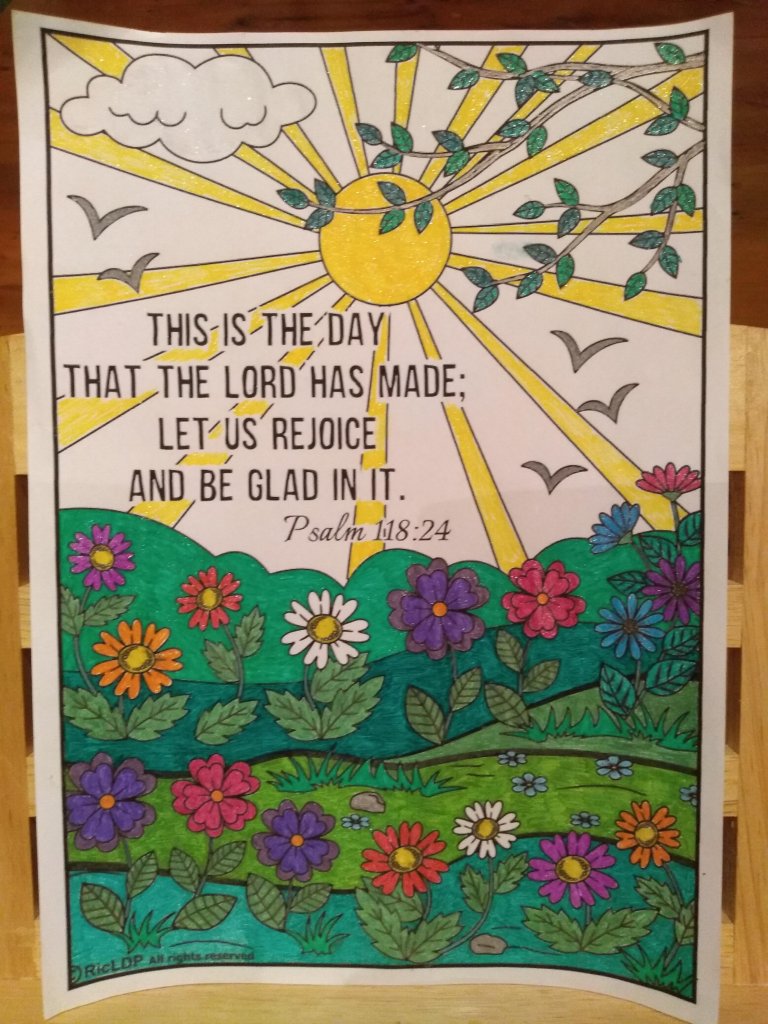
Last year, for the first time, I took notice of the fact that this day was coming, and I made a specific effort to celebrate my life. I coloured one of my favourite Bible verses, and posted about the day on Facebook. It was a valuable and empowering thing to do and it definitely helped me feel better.

So this year, I’m paying attention again. I didn’t die. There’s got to be a reason for that. Not everyone gets another chance.

But the thing is… because I almost died, I am not the person I was five years and one day ago. Many people talk about how becoming a parent changed their life. Becoming a parent changed my lifestyle, yes. It wasn’t easy (it rarely is). I had mild post natal depression for the first few months, and like several other people I know, I carefully answered the health visitor’s questions to avoid diagnosis. (Don’t do this, it isn’t a good idea and they are there to help you. If the situation ever arises again, I intend to be truthful.)

But it was on 12th May 2016, when we found out that our much wanted second child had died in my womb, that I began to change. It was on May 16th, when I haemmorraged and almost died, that I became a different person. My experience in hospital that night left me with PTSD, and the months and years ahead compounded the trauma and increased the depths of the grief and depression.

It took a while, but it was out of that grief and despair, trauma and sadness, that I began to seek joy. When I was in the depths for months on end, I began to focus on small things.

(The smell of sunlight on warm cat fur, the vibration of her purrs when she leans against my leg, the delight with which she runs to me, tail straight up in the air, when I ask if she wants me to brush her. )

To begin with, the tiny things were the only joy I could find.

(The rumbling of the kettle coming to the boil, the smell of hot water hitting the tea in the cup or pot, the pattern of the steam rising from my drink.)

I’m sure you remember being irritated, as a child, when adults told you that “practice makes perfect”. But it turns out that it’s true.

(Fresh bread, still warm from the oven, spread with butter and honey… crisp-skinned oven baked potato with cheese and coleslaw… crunchy, sharply sweet green apples… bright raspberries bursting with flavour…)

The more you practice celebrating the small joys, the more small joys you find to enjoy. It gets easier to find them and easier to appreciate them.

This isn’t a magic solution for banishing depressive thoughts, and it doesn’t remove anxiety. But it does make it easier to cope on the bad days, and it makes the good days better. It’s possible that it is also reducing the length of some of my depressive episodes, but that’s hard to measure.

(When my child flings her arms around me, and when she strokes my hair, and even when she pushes her dad over every evening after brushing her teeth.)

And sometimes it’s hard, really hard, to find any joy. Sometimes the small things seem so small compared to the big things that the energy needed to look for a small joy seems like too much effort. Those are the days when I try to remember to be kind to myself and patient with myself.

I try to bring joy to other people, too. Sometimes I send things in the post to people who are having a rough time. Sometimes I even let them know it’s from me (and sometimes it’s anonymous). Now that the cafés are open again, I’m meeting someone for a cuppa every week, which is a huge boost to my mental health (and hopefully isn’t too bad for theirs). I react and comment on social media (try not to underestimate what a difference that can make).

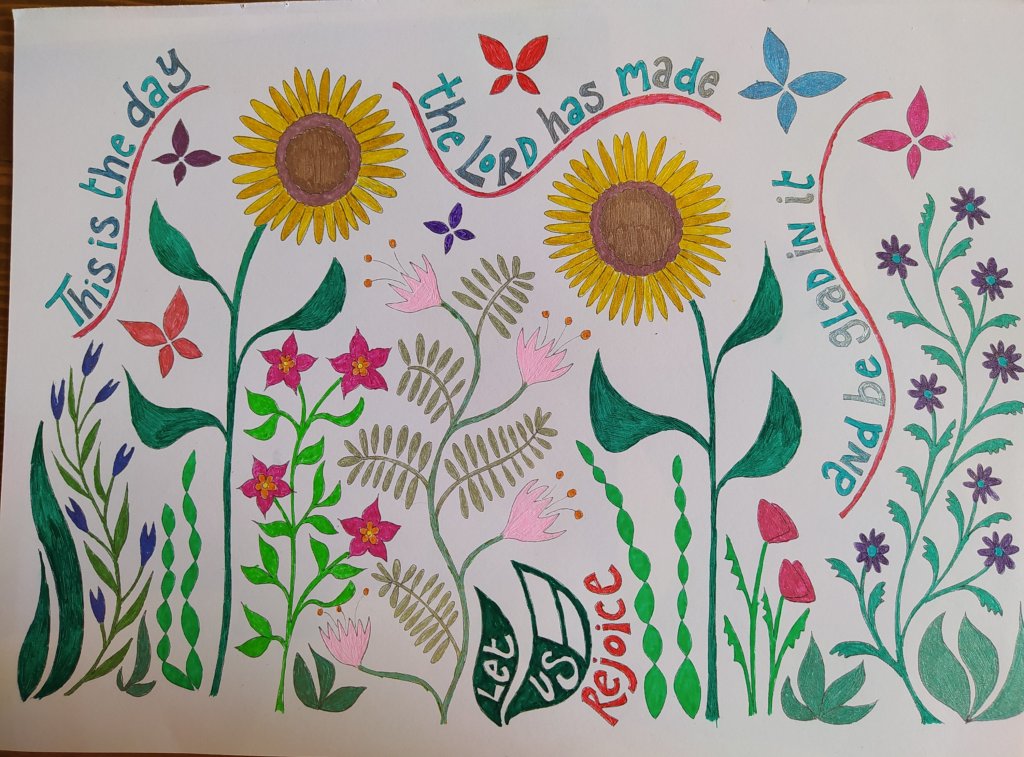
I’ve coloured a Bible verse again this year. It’s the same verse. Not only is it one of my favourites, it also seems particularly appropriate for today. This day, in particular, is the day the Lord has made. This is the day to celebrate living. I got another chance, and my life changed forever.

I’m also going to frame this as a gift. I’ve been praying for the people it’s for whilst I was colouring it, as well as praying for myself.

Spring and early summer are hard these days, and perhaps they always will be. But there is always something good, however small it is.

There’s a song rising up

Have you ever had the experience of hearing a song for the first time and finding that it belongs to you? Have you ever had a song sing itself into your heart so that you’re almost word and note perfect after one hearing?

The last time this happened to me was when Rend Collective issued Sing it from the Shackles on January 30th, 2020. I felt heard and validated after years of feeling abandoned by God.

Almost fifteen months later, I know I am not abandoned, but it’s head knowledge. Sometimes we know that something is true, it is a fact, but every feeling says the opposite. Most things can’t be separated: I know that the sky is blue with every part of me. But sometimes we can know something is true but feel quite different about it. I know that I am not abandoned. God does not abandon people. But I feel as though God has left me and is ignoring me. My head knowledge is that God is Love, always and forever, but my heart doesn’t feel it at the moment.

In my last blog, I talked about waiting and how lonely it is. It’s five years since we started trying for a second child. We wanted to have three children, close together in age. Now we know how lucky we are to have one, and we long for a second.

The truth is that I can’t pray for another child any more. Every night I say the words, it’s part of our regular bedtime prayer with K. But recently I’ve been beginning to think it would be more honest to leave it out, because I don’t really believe it will happen.

A year ago I was going through my sixth consecutive miscarriage, but my hope had been renewed. The fact that we conceived in the middle of a worldwide pandemic, when my health wasn’t great, renewed my belief that it would happen for us, that it was just a case of keeping on moving forward. Every day, every hour, every step is a step closer to the fulfillment of God’s promise.

But that was a year ago, and I don’t feel like that any more.

We have all been exhausted by this pandemic. I’m a long way from being the only person who was totally worn out before it even started.

I don’t have hope any more.

I can’t pray for myself at the moment. After five years it feels as though I am shouting into the wilderness. For a long time, I was able to suspend the emotions and pray anyway, because feelings are not facts. But it’s been so long that that’s not true any more.

About three years ago there was a 24 hour prayer event at our church. One of the activities there was a board of Bible verses. We were encouraged to write down a verse that came into our minds, and to take away a verse that spoke to us. The verse I took is Luke 1:45:

And blessed is she who believes that there would be a fulfillment of the things that were spoken to her from the Lord.

For a long time, that verse gave me strength every day. I still have that pink Post-it note. The glue is full of dust and cat hair, so it’s held onto our fridge with a magnet now. And I see it every day, many times a day, and it isn’t inspiring or strengthening or more, it’s just there.

I’ve been saying for a long time that I didn’t have the strength to carry on any more. There have been many days when I’ve laid my desire for another child at God’s feet and said, “Please, God. But not my will, your will be done. But please.” I can’t do it any more.

But this isn’t about me, and it never has been. Or perhaps it’s more accurate to say that it isn’t just about me, or even just about my family. This is, and always has been, about God. God is infinite and eternal, omnipotent and everlasting. God loves each of us with a parent’s love, and that includes not only me, my husband and child, but every one of our babies, too.

Our God is a parent whose child died.

My emotions don’t make a difference to God. God is bigger than anything to do with humans.

I feel abandoned, but I know I am not. I’m not giving up on God. I’m still praying for other people (please get in touch if you need prayer for any reason).

God made us a promise a long time ago, and the promise hasn’t changed. God hasn’t changed. I am the one who has changed.

There is a song rising up, from the chains, from the shackles, from the pit. For five years I have been singing to God, through darkness and loneliness, sadness and wilderness. I can’t sing any more. I can’t keep going in my own strength, because my strength has run out.

But every morning, I get out of bed. I get dressed, eat breakfast, care for my child before and after school. I cook meals and make bread. I should probably dust more often than I do, but that’s always true, not just now.

I am running on empty, but I’m still running. Where is my help coming from?

I sang to and for God for five years and my voice has run out, but the singing hasn’t stopped. I still hear that people are inspired by my story, that my daily thankfulness helps them, that they are encouraged by my words.

Maybe now I am a song. Maybe it’s God who is singing.

Standing on holy ground

I’m not a stranger to waiting. In February 1999 I was in a student bar with some friends, and I heard a voice inside my head saying, “That’s your husband. There. That one.” As I focused on the person, he and his fiancée started talking about their wedding plans. So I naturally assumed that I’d made a mistake, misheard or made it up inside my own head.

A few months later, the engagement ended and C and I became best friends. Actually, I fell head over heels in love, but although I kept hearing the same voice inside my head saying, “This is your husband. Hold on,” it wasn’t the right time and it soon became clear that my feelings weren’t reciprocated.

But I never met anyone else I liked as much. Over and over again I made a big effort to let go, to move on with my life, because I was clearly deluded. C had no desire to lose me as a friend, and also no desire for anything other than friendship.

Until he did. Eight years after I first heard a voice in my head naming him as my husband, and after seven and a half years of being in love with my best friend, he said that he loved me. We were married eighteen months later.

It all sounds very bald told in a few short paragraphs, but this is not actually the main story I want to tell today.

It’s very easy for me to say retrospectively that it was obviously the voice of God in my head telling me that this was my husband. But it wasn’t the first time I heard that voice inside my head, and it wasn’t the last time, either.

It’s become very common to talk in statistics these days. One in four pregnancies ends in miscarriage. One in eight couples live with some form of infertility. Of course, statistics like this make it clear how common these things are. It’s taboo to talk about baby loss and it’s taboo to talk about infertility, with the result that the many, many people who live with the consequences of one (or both) often feel alone and isolated, which only increases the pain and loneliness.

If you want to read my story in detail, you’ll find most of it in the other posts on this blog. Our daughter was conceived naturally after two years of unexplained infertility. When she was eight months old, we started trying for a sibling. In May 2016 I had my first miscarriage and almost died. In the next twenty months we lost five more babies.

I haven’t managed to write any blog posts for a year, because of quarantine and lockdown and everything else that’s been happening in the world. And so I haven’t written about our Hope.

In April 2020, after more than two years of secondary infertility, I suddenly and completely unexpectedly had a positive pregnancy test. For a few days we were full of joy and hope, and fear and trepidation. We were reminded that our God is a God of miracles and that nothing is impossible.

And then I went through my sixth consecutive miscarriage. Our brief burst of joy became the seventh baby in a row that we lost long before they were ready to meet us.

I said a few years ago, after losing six babies in twenty months, that I was only prepared to go through one more pregnancy. If I lost one more baby, that would be it. But to my surprise, when we lost this baby after only a few days, I didn’t feel like that any more.

After more than two years of secondary infertility, in the midst of a global pandemic, whilst we were in quarantine, I got pregnant.

Anything can happen. God can and does make miracles happen.

This particular baby didn’t get to be born. We aren’t struggling with sleepless nights and revelling in milky cuddles at the moment. But it is still a miracle that they lived at all.

Because our baby was a miracle, because all babies are miracles, we named our 2020 baby Hope.

And now, a year since our Hope came into being, we are still living with unexplained, secondary infertility. We have been in lockdown since Boxing Day, and this lockdown has been the hardest for most people I know.

People in general are not good at waiting these days. We’re used to ordering things online that arrive in a few days. When we want to find something out, we look it up instantly. We’re not good at patience. Everything is now, now, now. This is definitely one of the reasons why this last year has been so difficult for everyone. We are still waiting, and we don’t know when things will change.

There are definite signs of hope. I received my first vaccine dose three days ago. It’s easy to feel more hopeful when the days are longer, and when flowers start to come up in the garden.

Learning how to wait is not a bad thing in itself. There are excellent Biblical precedents for waiting for many, many years. Abraham was seventy-five and his wife Sarah was sixty-five when God promised that they would have a child, and they waited for twenty-five years until Isaac was born.

It’s five years since we started trying for a sibling. We never thought our little girl would still be an only child when she started school. Unless our miracle happens this month – which is always possible – we won’t have a child until 2022 at the earliest. These years have been full of doubts and questions and uncertainty, and grief, depression, anxiety and PTSD.

But what if waiting is the point? What if the act of waiting, praying and hoping means that we are standing on holy ground, listening to the voice of God, striving to believe, obediently standing by?

I find waiting difficult. You’d think I would be used to it, after waiting seven and a half years for the person I love to love me. This is harder, because there has been more loss and hurt and grief and because this time I’m not the only one. My husband and my living child are waiting too, and many of our friends and loved ones are waiting and praying with us. At least last time I had a lot of waiting to do, it was just me!

Waiting is lonely and miserable. It feels like being on an island or in a desert. I find it hard to pray or read the Bible. God feels distant and uncaring. It definitely doesn’t feel like standing on holy ground. It feels as though we have been abandoned.

When Sarah was eighty-nine, she laughed at the idea that she might give birth to a son. It was twenty-four years since God made his promise, and she was well past the usual child bearing age, so laughing seems human and reasonable. And a year later, her child was born.

I’ve spent a long time trying to work out whether I need to do anything different. But ultimately, all that comes back again and again, is… wait.

Wait.

Sometimes, waiting is doing God’s work.

Right now, the world is waiting… and we are waiting, too.

The Mourning and the Joy

I was a child in a family affected by baby loss. I am what is often referred to these days as a “rainbow”. My brother Jacob wasn’t three months old when he died. I don’t remember not knowing about him, and part of that knowing has always been that if Jacob had lived, I wouldn’t have been born. My younger brother died through medical error when I was three, several months before he was ready to be born. I remember my mother waking me up in the night, telling me that she was going to hospital because of the baby. I remember her coming home with empty arms, and I asked, “Where’s the baby?” and she told me the baby had died, and we both cried. In 1980 there was even less support for bereaved parents than there is now.

Parenting doesn’t look at all the way I expected it to. I knew it would be the hardest job I ever had, but I had no idea that, at least so far, I would only get to meet one of my children. I didn’t imagine that parenting would be coloured and affected by my physical illness, grief, anxiety, depression and PTSD. Of course K has been affected by this. She is very thoughtful and caring in general, and specifically protective of me. Sometimes this makes me feel guilty, because parental guilt is like that. But the truth is that just as I am not the person I would be if I had grown up as the middle one of three children, so K will never be the person she would have been if she had not lost six younger siblings by the time she was two and a half.

To most people, I am the mother of one child. But I have conceived seven children, it’s just that I don’t have the privilege of living with six of them. But they were created out of love. We were overjoyed when we found out about them and devastated by their loss. The loss of a baby is the loss of all their expected tomorrows. But their lives can still make a difference to other people, just as Jacob’s life still makes a difference, just as my un-named Little Brother’s life still makes a difference.

Today is Ash Wednesday, the first day of Lent. This is time when many people, Christian and non- Christian, give something up. Jesus spent forty days in the desert and the Devil tempted him to use his power for his own glory. For Christians, Lent was a time of fasting for centuries. The origin of Pancake Day is to use up the milk and eggs before Lent. Fasting is intended to help people to focus on God, and in more recent years there has been a recognition amongst Christians that fasting is not the only way to achieve this. And so some people, instead of fasting, have started to do something extra every day in Lent, to help them draw nearer to God.

Last year, on my personal Facebook page, I decided to write down something I was thankful for every day. I did this to focus on the joy instead of the mourning. After almost three years of grief related depression I wanted to remind myself how much there is in my life that is good.  I didn’t tell anyone that it was for Lent, but I did keep going for the whole time. It was immensely rewarding and I found it very helpful. After the end of Lent I plummeted into deep depression, as I do from time to time. This time I posted about it on Facebook. I was stunned by the number of people who commented on that post and via private message, saying that they were helped by my thankfulness posts. So I kept posting my thankfulness, not with any sense of discipline this time but just as it occurred to me. The late summer and autumn last year were difficult for me and plagued with physical illness, so in November and December I made a new formal commitment to find something to be thankful for every day. Once again I was bowled over by how many people have contacted me to say that my thankfulness has made a difference to them. And so this year, I have challenged myself to post something I am thankful for every day. It doesn’t always work! Sometimes I post in the morning for the previous day. I’ve been mired in depression again, and so this weekend I did one thankfulness post for both days. But it’s making a difference to me and to other people as well.

It’s four years this month since we conceived Gracie Wren. Four years since we were so happy and so full of optimism for the future. I do not believe that death is ever part of God’s plan, but I also believe that He can redeem anything. I believe I am a better version of myself than I was four years ago, and that is part of my angel babies’ legacy. And it’s Lent again. Since I’m committed to daily thankfulness for a whole year, I can’t use that as a way to draw closer to God this Lent. So here is my solution: this Lent I will undertake at least forty deliberate acts of kindness in memory of my angels. It won’t be one a day and it might be more than forty, but it won’t be less.

If you feel inspired by what I have written to undertake your own act of kindness or thankfulness, will you please comment here or on the Joy in the Mourning Facebook page? Thank you.

Whatever else you are, be kind

I wrote this in 2016 and it popped up on my Facebook memories yesterday morning:

“This year has been difficult in many ways. I’ve been laden with sadness for the last six months because of everything that has happened, politically and personally. I can’t control what has happened, any more than I could control it at the time, and I am still sad. And I still have all the challenges of being a full time parent. But I have decided to seek out things that bring me joy, and to try and bring joy to others. Advent starts on Sunday, and that’s always a season of joy.”

Reading it three years later makes me thoughtful. 2016 was a very sad and difficult year, the hardest year of my life so far… apart from 2017.

And yet, it’s clearly three years since I decided to look for joy in the small, everyday things. And it wasn’t long before I found out that one of the greatest sources of joy, for me, is bringing joy to other people – in other words, through kindness.

An act of kindness doesn’t need to be a big thing. Many kindnesses cost nothing. A couple of weeks ago, someone I passed in the street complimented me on my skirt and coat. I honestly felt brighter for hours! Coincidentally, only a few days before I noticed someone wearing a very attractive and unusual coat and I told them how lovely it was, and I saw a weight lift off their shoulders. Words are powerful.

A smile can be an act of kindness. Holding a door for someone. When I’m with my daughter, I am always delighted when a kind car driver slows down and waves us across the road.

Calling people out seems to be a very popular thing at the moment. Spot a mistake someone has made, or an opinion you disagree with. Discover that you have different political alliances, or that you don’t take the same approach to climate change, and call them out. Tell them, and in some cases their friends and loved ones, that they are wrong. I’m not sure what this is intended to achieve, but it seems to result in only sadness.

Here’s the thing: I don’t have to agree with all your opinions to be kind. Ultimately, whatever my political views; whatever daily action you take that appears hypocritical to me; whatever faux pas he, she or they commit regularly, we are all human. Most people, in my experience, are doing the best they can.

Of course, we all get it wrong. I’m human, I make snap judgments just like you. I get irritated when my child asks the same question for the ninetieth time, and when she claims that food that was delicious yesterday is the most disgusting thing in the world. But I always try to rethink. I looked down my nose at that person for wearing pyjamas to the supermarket, but what harm are they doing? I tut under my breath when I see a Christmas tree before the middle of December, but what right have I to be scornful when someone chooses a way of celebrating that’s different from me?

There is always room for more kindness in the world, and there is always something to be kind about. Advent is a season of joy, so why not go into this Advent season with the intention of performing one act of kindness every day. You might just find your life beginning to change.

After October

Baby Loss Awareness Month is over. The people who are reading this are probably in one of two groups. There are those who learned a lot, who lit a candle, who have wept with those who weep, who are a bit sadder and a bit wiser than they were a few weeks ago, who can now forget how common miscarriage and baby loss is and get on with their lives. If you are one of these people, I am not telling you that you’re wrong to do so. No-one who doesn’t need to should live in constant awareness of other people’s grief.

But those of us who can’t forget about it, those for whom this is our every day… we can’t put it behind us. There is no moving on from baby loss, there is no recovery. There is only moving forward, bearing a burden that for some of us is very heavy.

If miscarriage and baby loss are not part of your life, what can you do about it? Quite a lot, actually. Here are just five things that can make a big difference.

1) Remember them. A miscarriage isn’t a “failed pregnancy”. It isn’t an exam we didn’t revise for. These are our children. We don’t get to live with them, but they were wanted children. They were dearly beloved for the whole of their lives and they are still both dear and loved. Their lives matter.

2) Don’t be afraid to mention them. Maybe you avoid mentioning my losses because you don’t want to remind me, because you’re afraid you might make me sad. But I won’t ever forget. Mentioning them, saying their names, tells me that you remember, you care, that you take them seriously and think of them as real people.

3) Let me talk or be silent. Follow my lead. Sometimes I need to talk about my grief. Sometimes I am overflowing with things to say. Sometimes I can’t get any words out. Please accept whichever one it is. Letting me be myself with you is an immense gift.

4) Don’t be afraid of my tears. They are very near the surface these days. Don’t be put off if you say something kind and my eyes fill with tears. Those are probably happy tears, because you remember and you care.

5) Don’t try to cheer me up. Sometimes there isn’t a bright side. I know this one is counter-intuitive. It’s a human instinct to want to cheer people up when they’re feeling bad, and even more so when it’s someone we care about. That’s why so many people urge me to be thankful for what I have. But here’s the thing: gratitude and grief are not opposites. There are a lot of good things in my life and I’m very grateful for them. And also, I live with grief, depression and PTSD. Reminding me about the good things in my life doesn’t distract me from the difficult things. It makes me feel that I can’t talk to you about the things that are hard, it makes me feel that my grief is an imposition on you. So you will probably hear less about my grief, but that just means you are one more person who needs me to bottle it up.

None of these five things need to be onerous for you. I’m not trying to make you work hard. But these small actions can make a very big difference to the people in your life who are living with grief and loss, for whom October is both an oasis of light and a constant reminder of the sadness.

Mental Health Awareness Day

When I had my nervous breakdown in 1996, when I was nineteen, talking about depression was a big taboo and acknowledging that things were hard took a great deal of courage. That was more than twenty years ago, and these days we talk about mental health a lot more. People encourage their friends to be honest about how they are feeling, and people who are struggling are urged to reach out.

But that’s not the whole story.

Asking for help in the depths of depression is hard in ways that someone who has never been depressed can’t possibly imagine. Depression can make the sufferer feel that they don’t deserve help. It is hard to talk to anyone when things are bad.

We live in a world that values the appearance of happiness to an extraordinary and, I believe, unhealthy extent. We are encouraged to keep quiet about the things that are hard in case we make other people feel uncomfortable. This has the effect of making everyone feel isolated in their suffering, which makes it even harder to reach out.

People can be very judgemental about other people’s struggles. I have been told, in so many words, that because I live in a lovely house, have the luxury of being a full time parent, have a loving husband and a strong marriage, and only one child, I have nothing to complain about and no right to be sad because “other people have real problems”. But feelings are not mutually exclusive, and neither are facts. I absolutely have a lot to be thankful for. And also, I have had a number of very difficult and painful experiences in the last three years and I live with grief and PTSD every day. My pain matters.

In June last year I was referred by my GP to a local counselling service. In March I had an initial, introductory appointment and in May I had the first of twelve sessions. I’ve had five appointments so far, averaging one every three weeks. It has been incredibly helpful. I have been able to talk to this counsellor and have made huge strides in my understanding of my experiences and of my response to grief.

On Saturday 5th October I received a letter from the health authority informing me that the service had been terminated. I assumed that my booked appointment yesterday, Wednesday 9th, would go ahead and I intended to ask the counsellor if I could make a private arrangement for further counselling. Instead, the termination of the service was immediate and no-one took responsibility for making sure service users understood this. I don’t want to take up more space talking about this, but the careless way in which this was handled is a stark reminder that even health care professionals still disregard the significance of mental health.

I’ve written parts of my story before. In my twenties I learned to live with depression in a world that was much less open about such things than it is now. In my early thirties, depression almost ended my relationship: an excellent counsellor and a great deal of prayer helped us to build a strong marriage. After two years of trying and a difficult pregnancy we finally welcomed our daughter, and when she was eleven months old I had my first miscarriage and almost died. Five more losses followed in rapid succession.

I have been fundamentally changed. I am not the person I was in 2015.

After we lost Gracie Wren, I kept my mouth shut about what I was going through. I really believed it was my duty to keep quiet and to protect everyone else from my sadness. I began to open up, very tentatively, in October 2016 as a direct result of Baby Loss Awareness Week. My further losses have made me more and more aware that millions of families are suffering in silence because they believe that is the right thing to do. I want to encourage everyone who needs to, to speak out. What is troubling you might not be baby loss. It might be another kind of grief, or it might be your mental or physical health or that of a loved one. Of course, if it needs to be private, keep it so. But if you are keeping it secret because you think people don’t want to know, do speak up.

Your pain is personal to you, but until you talk about it, you will never know who needs the lifeline you are holding in your hands. You will never know who you can help with your experience.

So please talk. Please be open. Please share. And above all, be kind to other people, and also to yourself.

It’s all so heavy

People often tell me how well I look. I know it’s a compliment, so I smile and say “Thank you,” which is harder than it sounds. It may be shallow, but it is good to know that I’m looking good.

But as with any invisible illness, how I look is not the whole story. I smile, I laugh, I make jokes. I meet up with friends (not as often as I’d like to) and I post happy things on social media.

And my heart is still broken, and the tears are never far away.

I’m definitely not saying that it’s inappropriate or unhelpful to notice when people you know are looking well, especially if you know they’ve been having a hard time. It is helpful. But it’s not the whole story.

I am learning how to carry my load of grief. I am learning how to stretch the good times. I’m getting better and better at finding tiny nuggets of joy in the every day things.

(My daughter’s smile, and her chortles of pure delight… biting into a ripe nectarine… my cat’s soft fur and rumbling purr… music… the smell of the garden after rain… even the rain itself, if I am indoors… a really good cup of tea… there are lots of little things.)

But… the weight of grief never goes away. It doesn’t even get smaller. I mistakenly thought that as the physical recovery became a distant memory, emotional recovery would follow, although I was prepared for it to take a long time.

And maybe it will. Maybe it’s too soon. I don’t know.

Sometimes it’s easier to carry. Sometimes the little things are enough and the weight seems manageable. I get to the end of the day feeling tired, but not unreasonably so.

Sometimes, it’s just too much. Sometimes it’s a dead weight that gets heavier and heavier as the days go on, so that by three in the afternoon I’m so weary that I just want to curl up and cry. The little things are still there and they still bring some measure of joy, but it’s more of a temporary relief than a real respite.

And there isn’t anything I can do. I can’t curl up and sob, or go to bed, at three o’clock in the afternoon. So I keep on keeping on, one foot in front of the other, praying that it will get easier again. Tomorrow would be nice.

So if you tell me that I’m looking good and I hesitate before replying, or if you notice that my eyes fill with tears, it’s not you. It never is.

It’s just that it is all so heavy that it hurts.

Summer Holidays when Mummy is Sad

Today I helped K make a necklace and two masks. We walked into town, spent over an hour at the library, did some shopping, came home and had lunch. We watched Octonauts and Topsy & Tim, read several stories, and had lots of cuddles. I even managed to hang out the laundry and make broken biscuit cake (K was going to help but then decided she would rather make concrete soup and banana soup in the sandpit).

And because I’m in a depression slump, instead of looking at all we’ve done today and being pleased with such a successful, full day, and with the fact that she’s in such a good mood, I am fighting back the tears and arguing with myself because I feel like an utter failure. This is K’s fifth summer. When she was a tiny baby I had mild post natal depression. The year she was one I was still recovering physically after almost dying when we lost her first sibling. And the societal taboo against speaking about miscarriage meant I couldn’t talk to anyone about my experience. I thought it was more important to protect other people from what I went through than it was to work on my own healing.

The year she was two, we moved house at the beginning of June and lost the twins at the end of June, so I was a mess physically and emotionally. I had a lot of help and support for the first week, and then everyone moved on with their lives (as they should).

Last year my depression mostly manifested as numbness.

This year I feel so sad that I’m on the verge of tears almost all the time.Not only have I failed to give her a sibling, I can’t even help her have a good summer.

I know that is not true. She’s having a lovely summer, and although she wants to be a big sister she definitely doesn’t blame me because she isn’t. But this is one of the burdens of depression, for me. It tells me lies about my own life. I know they are not true, but they feel true. And sometimes the feelings are overwhelming.

I don’t think there is anything I can do, except try to practice compassion towards myself. I don’t think there is anything anyone else can do. Most parents find the summer holidays quite hard work as it is!

But I know that I am very far from being the only parent who feels that my illness is causing me to let my child(ren) down. I know with my head that I am not, and I know with my heart that you are not. Don’t forget that social media never tells the whole story, and that is not what it is for. We all use social media to share great pictures and happy times. Some of us also use it to try to express some of the difficult things life throws at us, but many people keep social media for the good bits of life and that’s fine.

Remember that ultimately, love is what matters most. If you’re having a really bad week, everyone you would usually ask for help is away, and you’re struggling to get out of the house at all… your child will not remember that. Make sure you have lots of cuddles. Do whatever you can and celebrate what you have achieved.

And if you read my list of what we did today at the beginning of this post and you were impressed by what you saw, remember that I spent the whole day feeling like a failure. I’m not a failure. I am doing the best I can.

If you are also doing what you can, try to have as much compassion for yourself as you do for others.